
THE NAME
Named for the man who taught
cameras to see, twice over.
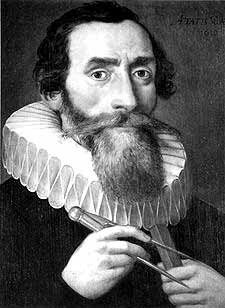
Johannes Kepler was first to describe how a lens bends light into a picture, and he gave the device its name: camera obscura. Every camera since descends from that page.
Then he did it again, higher up. His three laws of planetary motion turned the sky from something you hoped about into something you could predict. Order, written down as arithmetic.
Kepla inherits both halves. Light, captured: the app reads what your camera saw, frame by frame, on your own machine. And order: a shoot that arrives already sorted into clean, uncertain and set aside, with a reason on every frame and nothing deleted. Optics, then order. Both halves of the name.
THE SILVER MARK · 2026
THE MARK
Three sheets of glass,
and one lit pixel.
01 · THE STACK
The pile, in order
A shoot is a stack: thousands of frames deep, most of it passes over the same moment. The two frosted sheets are the frames set aside · still there, faded back, never deleted. Nothing in the mark disappears, because nothing in the product does.
02 · THE PANE
The clean set on top
The top sheet is polished silver: the clean frames, lifted off the pile and handed to you. Its dot matrix is a sensor’s photosites · every frame read, every frame accounted for.
03 · THE GOLD PIXEL
The one you choose
One photosite is lit gold. That is not Kepla’s choice; it is yours · the favorite you mark. Gold in this brand is reserved for what the photographer decides, and this is its only appearance in the mark.
04 · THE MATERIAL
Glass, because lenses
The mark is glass and light, nothing else. It began as the K with the blue photon dot, the particle of light Kepler spent his life chasing; the silver mark carries that story forward in the material itself.
THE VISION
Every shoot opens
already cleared.
Where this is going, plainly. Not a taste machine. A first pass so good you stop dreading the pile.
01
The looking is the bottleneck
A wedding is 4,000 to 5,000 frames and four to eight hours of looking before a single creative decision gets made. Most of that looking is at blinks, duplicates and misses. That is the part a machine should carry.
02
The choosing stays human
Kepla clears the obvious misses and names the reason on every frame it sets aside. It never picks your best shot, because taste is the job. The division of labour is the product: we clear, you select, you heart favorites.
03
On your machine, always
Your card never uploads. The work runs on your own Mac, offline, inside the time the card copy already takes. Privacy is not a plan tier; it is the architecture.
04
The work around the work
Culling first. Then the small jobs around it: the one frame a client needs tonight, the metadata check, the resize. The free tools on this site are that vision in miniature · each one runs in your browser and uploads nothing.
CORE VALUES
Commitments we would rather
be held to than explain.
Written down so you can quote them back at us.
01
Nothing is ever deleted
Kepla never deletes, moves or renames a frame, never writes a reject flag, never writes to the card. Set aside means set aside: one key from coming back, forever.
02
Nothing is ever uploaded
The cull runs on your Mac with the wifi off. No queue behind other customers, no copy of a client’s wedding on someone else’s disk, no terms of service between you and your own files.
03
No lock-in, by design
Decisions land in XMP sidecars beside your files, readable by Lightroom, Capture One and Bridge without us. If Kepla vanished tomorrow, your cull survives it. Lock-in is a business model, not a feature.
04
We charge for software
Free through the private preview. The founding hundred keep it at $99 a year, then it goes to $180. No commission, no percentage of anything you sell, and founding members vote on what ships next.
WHAT IS FREE
The tools are free because
the app is not.
Kepla for Mac is what pays for these. Nothing here is a trial, and none of it expires.
01
Free file transfer
Send up to 10 GB to a client in one link, free, with no account and no card. You choose how long the link lives, up to three days, then the files are deleted from storage. No monthly cap and no transfer count, because there is no plan to move you onto.
02
Metadata remover
Take the GPS coordinates, the camera serial number and the timestamps out of a photo before it goes anywhere. It runs entirely in your browser: the file never leaves your machine, and the tool never asks for your email address.
03
RAW to JPG
CR2, CR3, NEF, ARW, RAF, ORF, RW2 and DNG into JPEG without opening Lightroom, for the one frame you need tonight. Also in the browser, with nothing uploaded.
There are more of them · an EXIF viewer, a culling time calculator, a social image resizer · all on the free tools page.
WHY IT MATTERS
The photographer nobody discovered until it was too late.
Vivian Maier worked as a nanny and shot more than 150,000 street photographs. Almost none were seen in her lifetime · not for want of talent, but because the work around the work never got done. Her negatives sat in a storage locker until a stranger bought them at auction.
Every working photographer is one bad season of backlog away from that locker. The pile grows faster than the looking, and the looking is what buries the pictures. Kepla exists so it never does. You will meet her name inside the product, on purpose.